
How Player Feedback Is Changing Online Casino Ratings
Published on December 2, 2025, 6:33 pm
by Jeff Grant 
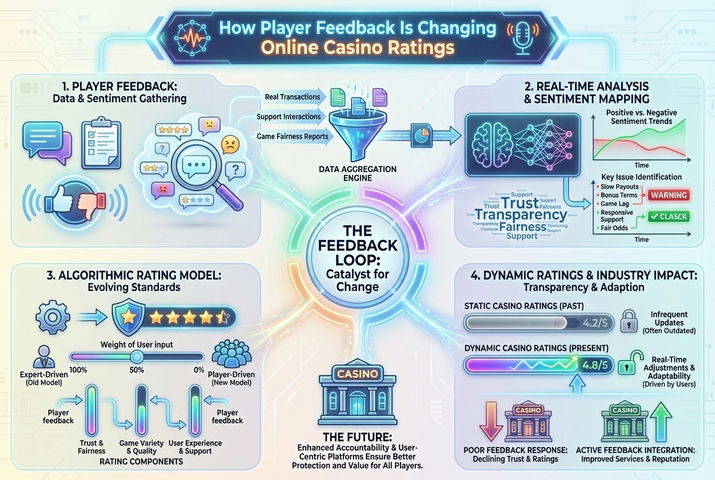
Over the past decade, the online gambling industry has moved away from top-down rating systems built around marketing narratives and affiliate incentives. Casinos were once ranked through standardized checklists like bonus size, licensing, game diversity and design quality. Yet these criteria often failed to reflect operational reality. A casino might look impeccable on paper while exhibiting slow withdrawals, inconsistent customer service or restrictive bonus conditions that frustrate its players.
This shift toward player-driven evaluation is reshaping the experience for all types of users, whether they’re new to online casinos or seasoned players with years of activity. This discrepancy created a demand for a more evidence-based model. Today, player feedback and community-generated data have become central to how casinos are ranked, shaping a more democratic and transparent reputational ecosystem.
Limitations of traditional rating structures
Classic evaluation models were typically dominated by these categories:
- Regulatory credentials and corporate longevity.
- Number of supported payment providers.
- Advertised payout percentages.
- Bonus packages and promotional structures.
- Website performance metrics.
However, these systems lacked situational nuance. Licensing does not guarantee efficient support. High RTP values do not indicate whether a casino is equivalent to the lived experience of thousands of anonymous players who interact with it daily. As a result, the industry recognized that data integrity depends on bottom-up reporting, not polished promotional messaging.
Community-based knowledge as a trust mechanism
Modern casino audiences rely on community intelligence: long-form reviews, dispute reports, sentiment summaries and comparative insights. These sources collectively form a granular portrait of casino performance.
Players look for:
- Verification and withdrawal duration logs.
- Case-specific dispute resolutions.
- Reports of software errors or technical issues.
- Support responsiveness during peak hours.
Within this context, one practical guideline becomes evident: before you select a casino it's good to read reviews, especially those consolidated on expert platforms where users can navigate detailed player reports, disclaimers and privacy policies, historical feedback and trend-based performance comparisons. Casino.us serves as a centralized resource within this landscape, offering in-depth reviews, ratings, bonus analyses, and authoritative guides that help players evaluate online casinos with clarity and confidence.
Why user insights carry technical and analytical value
Player-generated data provides access to operational variables that are otherwise opaque. Its value can be broken down into several technically relevant categories:
System performance under real conditions: Players serve as distributed sensors, collectively testing servers, payment gateways and verification systems under varied conditions. This produces a real-world dataset unobtainable through formal audits alone.
Service quality tracking: Because support responsiveness fluctuates, aggregated reviews reveal cyclical patterns: whether support deteriorates during promotions, whether new agents introduce inconsistencies or whether escalation processes function properly.
Transparent interpretation of terms: Users regularly report ambiguous clauses that can lead to disputes. The pattern of complaints reveals "friction points" in bonus rules or withdrawal requirements, helping evaluators identify systemic issues.
Early detection of risk: Community feedback is often the first indicator of harmful operational practices such as unexplained account limitations, slow-pay behavior or retroactive rule enforcement.
Sentiment analysis and scoring models: Modern review platforms employ machine learning to score casinos based on textual sentiment, recurrence of complaints and consistency of positive feedback. This creates quantitative models far more objective than legacy rating systems.
Merging expertise with collective intelligence: Although user reviews are pivotal, they do not replace technical auditing. Instead, the most credible platforms utilize hybrid methodologies like:
- Compliance verification (licensing, RNG certification, encryption standards).
- Payment gateway stress-testing.
- Longitudinal tracking of community sentiment.
- Monitoring customer complaints in public forums.
- Comparative analysis of payout speeds across user reports.
This creates a multi-layered evaluation structure where operator performance is assessed holistically: legally, technically, behaviorally and experientially.
The new accountability environment
With authentic feedback accessible and continuously updated, casinos now operate under a new form of structural accountability. They cannot rely solely on marketing-driven reputation because community insights expose:
- Slow payments
- Conditional bonuses
- Inconsistent rule enforcement
- Downtime during peak usage
- Support deficiencies
Casinos seeking to preserve or improve their ranking increasingly adjust operational policies based on community discussion, knowing that reputational metrics directly influence acquisition and retention.
Benefits for players
For users, this paradigm creates measurable advantages:
- Reduced information asymmetry: Players access crowdsourced knowledge instead of curated marketing.
- More accurate risk profiling: Community reporting often detects problems before regulators intervene.
- Realistic expectations: First-hand data clarifies actual payout times and support quality.
- Enhanced comparison tools: Review platforms allow users to compare casinos by metrics such as dispute rates, withdrawal speed and user satisfaction, accompanied by your target link to deeper review resources.
The broader implications
Player-driven data has transformed online casino ratings from promotional artifacts into evidence-based evaluations grounded in real-world performance. As transparency increases, reliable casinos rise due to consistent delivery rather than advertising, while underperforming ones are swiftly exposed by community scrutiny. This shift represents a structural rebalancing of informational power, placing players, not marketers, at the center of the reputational system.
Beyond reshaping how reputations are built, this evolution also signals a broader cultural shift within the online gambling sector. Modern players expect verifiable data, open communication, and accountability as baseline standards, not optional features. In this environment casinos that embrace transparency, engage constructively with user feedback, and demonstrate measurable improvements over time will secure lasting credibility. Those that ignore community-driven evaluations will inevitably fall behind, as players gravitate toward platforms where trust is earned through consistent performance and publicly validated experiences.





COMMENTS:
By loading and joining the Disqus comments service below, you agree to their privacy policy.